Boot information, normalization and ownership
Scope
Boot information is not merely a bag of values handed to the kernel.
It is a lifetime and ownership problem.
At kernel entry, ChrisOS receives data created by an external environment. Today that environment is Limine. In the future it can also be ChrisVM or another boot adapter.
The kernel must answer four different questions for every piece of boot state:
- what fact is being communicated;
- where the original bytes live;
- how long those bytes remain valid;
- whether the kernel has copied the fact into memory it owns.
Those questions determine whether memory can be reclaimed safely.
The current ChrisOS code only partially normalizes Limine state.
It copies some scalar values into struct bootinfo, but it keeps direct pointers to Limine-owned structures for the memory map and multiprocessor response.
That distinction is the center of this chapter.
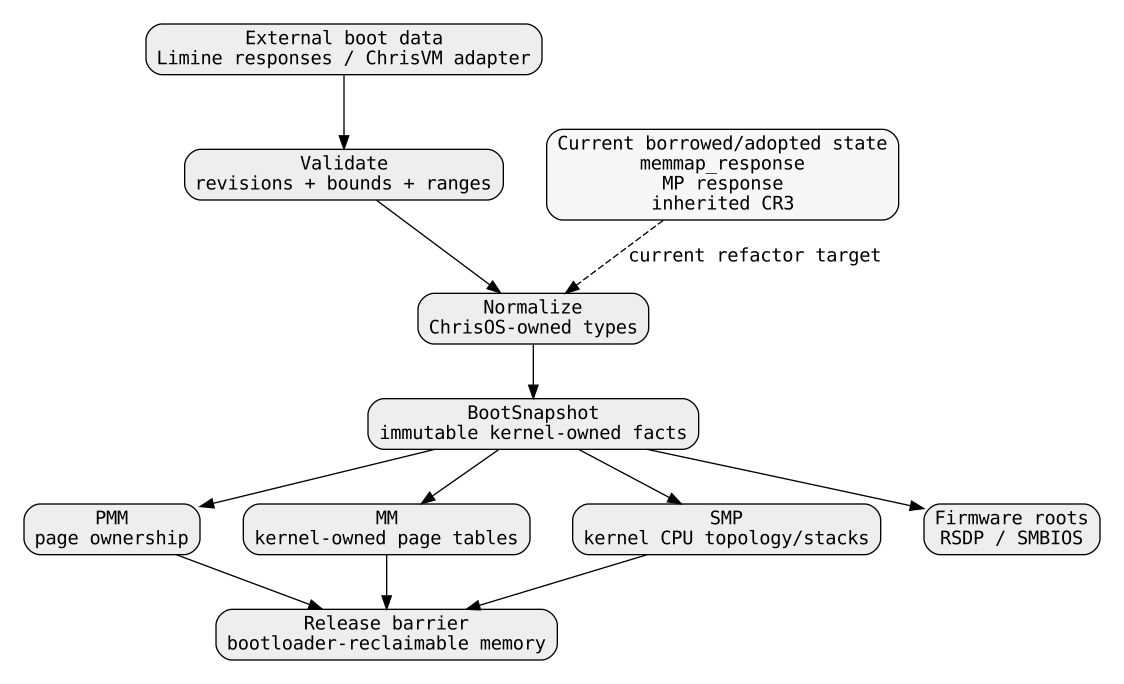
External protocol data versus kernel state
At entry, Limine is the producer.
ChrisOS is the consumer.
Conceptually:
external boot protocol
      |
      v
raw boot responses
      |
      v
validation
      |
      v
normalization
      |
      v
kernel-owned boot snapshot
      |
      v
PMM / MM / SMP / graphics / ACPI
The current implementation stops halfway:
Limine responses
      |
      +-- copy scalars into struct bootinfo
      |
      +-- keep memmap_response pointer
      |
      +-- keep mp_request.response pointer
This means protocol objects remain part of the live kernel state.
What normalization means
Normalization converts bootloader-specific data into kernel-defined data.
The purpose is not merely prettier naming.
It provides architectural decoupling.
For example, instead of every subsystem depending on:
the kernel can expose:
Then Limine becomes one adapter rather than the data model of the entire kernel.
The same principle applies to CPUs, framebuffer description, firmware roots and command-line options.
Ownership vocabulary
This chapter uses four ownership classes.
Borrowed
The kernel can read the object, but the storage belongs to the bootloader.
Example today:
Copied
The kernel has duplicated required fields into its own static or allocated memory.
Example today:
Adopted
The kernel begins using an object created by the bootloader as its own runtime object.
The strongest example today is the active page-table hierarchy referenced by CR3.
ChrisOS does not merely read it; the memory manager extends it.
Reclaimable
Storage can be returned to the allocator only after no borrowed or adopted object depends on it.
This is a proof obligation, not merely a memory-map type.
Current struct bootinfo
The current header defines a deliberately small structure:
struct bootinfo {
    hhdm_offset
    fb_addr
    fb_width
    fb_height
    fb_pitch
    fb_bpp
    usable_bytes
    memmap_entries
    cpu_count
    bsp_lapic_id
}
These are scalar values copied from Limine responses.
Once copied, these individual fields no longer require the original response objects to remain valid.
However, other APIs still expose original response data.
Scalar snapshot versus full snapshot
The current struct is better described as a scalar summary than a complete boot snapshot.
It omits:
- copied memory ranges;
- copied CPU descriptors;
- bootloader identity;
- firmware type;
- RSDP;
- SMBIOS roots;
- framebuffer color masks;
- framebuffer memory model;
- command-line copy;
- executable physical base;
- executable virtual base;
- protocol/base revision metadata;
- paging mode;
- provenance information.
The missing fields are not all mandatory.
The point is that the kernel currently lacks one complete internal object describing everything it intends to keep.
Why pointer retention matters
Suppose bootinfo_init copied every memory range into kernel memory.
Then the original Limine memmap response could eventually be discarded.
But today bootinfo_memmap_entry does:
on every call.
Therefore PMM and any later consumer still require the Limine response tree.
Similarly, smp_init obtains:
which returns the original Limine MP response.
So two major kernel subsystems still depend directly on bootloader-owned objects.
Memory ownership graph
The current dependency graph is approximately:
Limine bootloader-reclaimable memory
  |
  +-- memory-map response
  |      |
  |      +-- entry pointer array
  |      +-- entry objects
  |             |
  |             +--> PMM queries
  |
  +-- MP response
  |      |
  |      +-- CPU pointer array
  |      +-- per-CPU objects
  |             |
  |             +--> SMP bootstrap
  |
  +-- initial page tables
  |      |
  |      +--> active CR3
  |      +--> kernel MM modifies them
  |
  +-- entry/AP boot stacks
This graph explains why BOOTLOADER_RECLAIMABLE cannot yet simply be released.
Lifetime categories
A robust boot architecture should classify information by lifetime.
Entry-only
Required only before or during initial transition.
Examples can include:
- loader temporary stack metadata;
- raw protocol markers;
- transient loader handles.
Early-boot
Needed until a kernel subsystem takes ownership.
Examples:
- raw CPU descriptors until SMP has copied topology;
- raw memory map until PMM has built its internal state;
- loader page tables until kernel-owned page tables are active.
Persistent
Information intentionally retained for the lifetime of the kernel.
Examples:
- normalized physical-memory topology;
- framebuffer geometry;
- firmware roots;
- system identity;
- kernel image provenance.
Conditionally reclaimable
Information needed until a subsystem finishes consuming it.
Examples:
- ACPI reclaimable regions after required tables are copied/parsed;
- bootloader-reclaimable responses after normalization.
Current initialization order
kstart calls bootinfo_init very early.
Later major consumers are initialized in approximately this conceptual order:
bootinfo_init
   |
GDT / IDT / interrupts
   |
PMM
   |
MM
   |
heap and runtime state
   |
graphics
   |
APIC / SMP
   |
ACPI
   |
storage / filesystem / desktop
This order creates an important design issue.
If bootloader data is to be reclaimed early, every consumer that still uses it must either:
- run before reclamation; or
- consume a kernel-owned copy.
A BootSnapshot solves the second case.
BootSnapshot design goal
The desired internal structure should be independent of Limine.
Conceptually:
BootSnapshot
{
    protocol;
    firmware;
    kernel_image;
    hhdm;
    framebuffer;
    memory_ranges[];
    cpus[];
    firmware_roots;
    command_line;
    provenance;
}
This is not necessarily one literal giant C struct.
It is an architectural ownership boundary.
The important property is:
Snapshot immutability
Most boot information is immutable after entry.
That suggests an internal API such as:
Mutability should be limited to early construction.
Once finalized:
- memory topology should not be rewritten casually;
- boot CPU topology should be treated as historical entry data;
- command line should be immutable;
- firmware root addresses should remain stable facts.
Runtime hotplug data, if added later, belongs elsewhere.
Normalized memory ranges
The memory map is one of the most important pieces to normalize.
A kernel-owned range can be:
The type should be a ChrisOS enum rather than a Limine numeric constant.
Possible internal types:
BOOT_MEM_USABLE
BOOT_MEM_RESERVED
BOOT_MEM_ACPI_RECLAIM
BOOT_MEM_ACPI_NVS
BOOT_MEM_BAD
BOOT_MEM_BOOTLOADER
BOOT_MEM_KERNEL
BOOT_MEM_FRAMEBUFFER
BOOT_MEM_MMIO
BOOT_MEM_UNKNOWN
The exact enum can evolve without leaking the external protocol ABI.
Why retain original type metadata
Normalizing does not mean losing information.
If a future Limine revision introduces a new memory type, the adapter can preserve:
- normalized category;
- raw protocol type;
- flags indicating incomplete interpretation.
This is safer than silently mapping every unknown type to usable memory.
Unknown memory must default to reserved.
Memory map invariants
Before a range enters the snapshot, validate:
- base is representable;
- length is nonzero or intentionally ignored;
- base + length does not wrap;
- page-alignment behavior is explicit;
- type is known or mapped to reserved;
- range count stays within a configured bound.
The raw boot map is external input.
It should be parsed defensively.
Sorting
Bootloaders often provide ordered maps, but the kernel should decide whether sorted order is an internal invariant.
A normalized snapshot can sort by base address.
Advantages:
- easier overlap detection;
- simpler diagnostics;
- deterministic tests;
- easier adjacent-range coalescing.
The adapter must not assume sorting unless the external protocol explicitly guarantees it.
Overlap detection
After sorting by base, ranges can be checked with:
If ranges overlap, possible policies are:
- panic as malformed input;
- apply explicit priority rules;
- split ranges into non-overlapping canonical segments.
For ChrisOS, failing closed is preferable during early hardening.
Silent overlap resolution can mark reserved hardware memory as usable.
Adjacent-range coalescing
Two adjacent ranges with the same normalized type can be merged:
This reduces range count.
However, raw provenance can be useful for debugging, so coalescing should occur only after validation and optionally preserve source metadata.
Page alignment is not protocol normalization
The boot snapshot should preferably retain exact byte ranges from the bootloader.
PMM can later transform them into complete-page geometry.
Why?
Because these are different concerns:
Mixing them loses fidelity.
PMM transformation
Current PMM correctly applies asymmetric alignment:
This ensures only wholly usable pages become free.
A future normalized map should preserve this rule at the PMM boundary.
Memory-map capacity
The snapshot needs a finite capacity or dynamic allocation strategy.
Using dynamic allocation during the earliest boot phase introduces a circular dependency because heap/PMM may not yet be initialized.
Options include:
- fixed static array with a strict maximum;
- boot arena carved from known kernel BSS;
- two-pass sizing and later heap copy;
- early allocator dedicated to boot metadata.
A fixed array is simplest initially.
Fixed array sizing
For example:
would allow deterministic storage.
If the external map exceeds capacity, the kernel should fail clearly rather than truncate silently.
The actual number should be chosen from observed firmware maps plus margin and tested across machines.
CPU topology normalization
The MP response should also be copied.
A kernel-owned descriptor can contain:
struct boot_cpu {
    uint32_t processor_id;
    uint32_t apic_id;
    uint32_t logical_index;
    uint32_t flags;
};
This lets SMP stop depending on struct limine_mp_info after handoff.
BSP identity
The snapshot should explicitly identify the BSP.
Do not require every consumer to infer BSP status by comparing APIC IDs repeatedly.
Possible fields:
This also creates one place to validate duplicate APIC IDs.
CPU-count bounds
Current bootinfo verifies cpu_count is nonzero.
A hardened adapter should also reject or clamp according to explicit capacity.
SMP already has project limits such as SMP_CPU_CAP and SMP_MAX_APS.
The boot adapter should reconcile incoming topology with those limits before downstream code indexes fixed arrays.
Duplicate CPU identifiers
Malformed topology can contain duplicate:
- processor IDs;
- LAPIC IDs.
These should be detected during normalization.
Duplicate APIC IDs can cause interrupts, TLB shootdowns and CPU accounting to target the wrong logical CPU.
That is not merely diagnostic metadata.
x2APIC future-proofing
Current code uses uint32_t LAPIC IDs but several lookup structures mask IDs to 8 bits.
A BootSnapshot should not bake that truncation into the boot ABI.
Keep full-width APIC identifiers in the normalized topology.
Any xAPIC-only restriction belongs in the APIC/SMP subsystem.
MP startup and ownership timing
There is a subtlety.
Limine MP descriptors are not only data.
Their goto_address and extra_argument fields are an active synchronization interface used to start APs.
Therefore the kernel cannot drop the raw MP response before AP handoff completes.
The sequence should be:
copy topology
   |
allocate kernel AP state/stacks
   |
program Limine goto_address
   |
wait for AP handoff
   |
verify APs are on kernel-owned stacks
   |
drop Limine MP objects
This is different from memory-map normalization, where a deep copy can remove the dependency immediately.
Framebuffer normalization
Current bootinfo copies geometry but loses color-layout information.
A fuller descriptor can contain:
address
physical_address if known
width
height
pitch
bpp
memory_model
red_mask_size
red_mask_shift
green_mask_size
green_mask_shift
blue_mask_size
blue_mask_shift
The kernel graphics layer can then decide whether the mode is supported.
Virtual versus physical framebuffer address
Limine gives a mapped framebuffer virtual address.
For ownership purposes, distinguish:
The physical backing can be derived once the inherited page tables are still active.
If the kernel later replaces the page tables, it needs the physical address to recreate the mapping.
Therefore physical framebuffer identity should be captured before page-table replacement.
Framebuffer size arithmetic
A framebuffer byte-span cannot safely be calculated only as:
because pitch may exceed visible row width.
The memory span needed for scanout access is more accurately based on:
with checked multiplication.
Both values can overflow if boot input is malformed.
Pixel format validation
A 32-bpp framebuffer can still use unsupported channel masks.
Normalization should copy the masks first.
The graphics backend can then classify:
Current code only checks bpp == 32.
HHDM normalization
HHDM is currently copied as a scalar offset.
That is useful but incomplete.
The kernel also needs to know where the direct-map operation is valid.
A future internal HHDM model can expose:
rather than encouraging arbitrary:
casts.
This would encode the mapping policy derived from the normalized memory ranges.
Physical-to-virtual conversion API
Current:
blindly adds the HHDM offset.
A safer API can be split:
The second operation can panic or return null if the range is not guaranteed mapped.
MMIO must continue through explicit mapping APIs.
Command-line ownership
Current bootflag_parse reads the Limine command-line string immediately and copies only interpreted booleans/enums into static globals.
This means the kernel does not need the command-line string later for those flags.
That is already a good normalization pattern:
If the shell or diagnostics later need the raw command line, copy it explicitly into bounded kernel storage.
Command-line limits
The parser currently walks until NUL without an explicit maximum.
The bootloader is trusted, but a defensive adapter should enforce a maximum such as:
before tokenization.
The copy should always be NUL-terminated.
Unknown flags
Unknown boot flags are currently ignored.
That can be acceptable for forward compatibility.
A useful diagnostic mode could log unknown tokens so typos such as:
do not silently appear to work.
Firmware roots
A normalized boot layer is the right place to carry roots such as:
- RSDP;
- SMBIOS entry points;
- EFI System Table if intentionally retained;
- device tree on non-x86 targets.
Subsystems should consume these roots through internal boot APIs rather than depend on Limine request types.
RSDP ownership
An RSDP pointer is not the same thing as copied ACPI tables.
The snapshot can store the physical or protocol-defined address of the RSDP.
Then the ACPI subsystem can:
- validate RSDP;
- find XSDT/RSDT;
- validate tables;
- decide which table bytes must remain accessible;
- reclaim ACPI reclaimable memory only after lifetime is resolved.
Boot normalization and ACPI ownership are separate stages.
SMBIOS ownership
Likewise, SMBIOS entry points can be stored in boot state while the SMBIOS subsystem decides what to parse and retain.
The boot layer should not turn into a SMBIOS parser.
It should transport validated roots.
Bootloader identity
A persistent snapshot should ideally record:
This greatly improves bug reports.
For example:
This is much more useful than merely knowing the kernel reached kstart.
Kernel image identity
The boot environment can also provide or help derive:
- kernel physical base;
- kernel virtual base;
- executable size;
- loaded modules.
The project already values build ID and SHA256 provenance.
A BootSnapshot should connect bootloader provenance with kernel artifact provenance.
Snapshot and security
Boot information is privileged input.
If the bootloader is compromised, the kernel cannot fully protect itself from malicious page tables or fabricated memory maps.
However, defensive validation still matters because it catches:
- firmware bugs;
- bootloader bugs;
- accidental corruption;
- incompatible revisions;
- emulator defects;
- future adapter mistakes.
Trust and validation are not mutually exclusive.
The inherited page-table problem
Even after all metadata is copied, the current kernel still depends on bootloader-owned page tables.
mm_init reads:
and stores it in:
Then map_4k and related functions extend that same hierarchy.
This is adoption, not normalization.
Why replacing page tables matters
A kernel-owned root provides:
- clear lifetime;
- known permissions;
- known direct-map geometry;
- no hidden loader-only mappings;
- safe bootloader-memory reclamation;
- easier ChrisVM parity;
- reproducible paging layout.
The replacement should occur only after enough physical memory is available to allocate the new hierarchy.
Page-table transition plan
A staged migration can be:
1. parse and copy boot memory map
2. initialize PMM
3. allocate new PML4 hierarchy
4. map kernel ELF
5. map kernel stack
6. build HHDM for intended ranges
7. map framebuffer
8. map required MMIO windows
9. switch CR3
10. verify translations
11. retire inherited tables
The exact ordering must keep code, stack and data continuously mapped.
Mapping the currently executing instruction
When switching CR3, the new page tables must already map:
- the current RIP page;
- current RSP stack pages;
- global data used immediately after the write;
- page-table manipulation code;
- interrupt/trap structures if interrupts can occur.
A page-table handoff is an executable transition, not merely a data copy.
TLB behavior
Writing CR3 changes translation context and invalidates relevant TLB state according to x86 semantics.
The boot-time switch occurs before normal SMP traffic if possible.
Doing it before APs are fully active simplifies TLB coordination.
This is another reason to choose the ownership transition point deliberately.
BSP stack transition
The BSP entry stack is also bootloader-owned.
ChrisOS currently later relies on a linker-reserved stack for TSS rsp0 but does not immediately switch the BSP runtime stack to it.
A complete ownership transition should explicitly move RSP to a kernel-owned BSP boot stack before reclaiming loader memory.
AP stacks
APs already perform a more explicit transition.
smp_init allocates PMM-backed stacks and ap_entry switches RSP before entering normal worker code.
This makes AP stack ownership clearer than BSP stack ownership.
The BSP should eventually follow the same principle.
Reclamation barrier
Bootloader-reclaimable pages can only be freed after all of these are true:
memory map copied
MP topology copied
AP bootstrap finished
BSP on kernel stack
APs on kernel stacks
new kernel page tables active
no response pointers retained
no loader modules needed
no bootloader data structures referenced
This is a barrier.
Reclamation before the barrier is unsafe.
Reclaim API
Rather than letting PMM silently reinterpret memory types at arbitrary times, use an explicit transition such as:
The function should assert the barrier conditions.
It can then convert eligible normalized boot ranges into PMM-free pages.
This makes lifetime visible in code.
ACPI reclaim barrier
ACPI reclaimable memory has a different barrier.
It becomes eligible only when the ACPI subsystem confirms the necessary table contents no longer require those original pages.
Therefore there can be multiple release phases:
Resource lifetime should be phase-specific.
Boot phases
A useful boot state machine is:
BOOT_RAW
  |
BOOT_VALIDATED
  |
BOOT_SNAPSHOT_READY
  |
BOOT_PMM_READY
  |
BOOT_KERNEL_PAGING
  |
BOOT_SMP_HANDOFF_DONE
  |
BOOT_BOOTLOADER_RELEASED
  |
BOOT_RUNTIME
Subsystem APIs can assert a minimum phase.
This catches accidental use of raw loader data after release.
Current bootinfo_ready flag
Today bootinfo has one boolean:
It only distinguishes:
A richer state machine would encode ownership transitions more accurately.
Why bootinfo is currently coupled to Limine
bootinfo.c contains both:
- protocol declarations;
- protocol validation;
- command-line parsing;
- kernel-facing accessors.
That makes it both adapter and kernel boot database.
A cleaner structure is:
boot/limine.c
    raw Limine adapter

boot/snapshot.c
    normalization + ownership

boot/config.c
    command-line policy

kernel subsystems
    consume only snapshot/config APIs
This reduces external protocol leakage.
Header coupling
bootinfo.h forward-declares:
and exposes:
That is the strongest visible protocol leak in the public bootinfo API.
A kernel-internal normalized CPU interface would remove Limine from this header entirely.
Desired public API
A future header can expose only ChrisOS types:
const struct boot_snapshot *boot_snapshot_get(void);

uint64_t boot_memory_count(void);
int boot_memory_range(index, struct boot_mem_range *);

uint32_t boot_cpu_count(void);
int boot_cpu(index, struct boot_cpu *);

const struct boot_framebuffer *boot_framebuffer(void);
const struct boot_firmware_roots *boot_firmware(void);
No Limine type needs to appear.
ChrisVM integration
ChrisVM v1 has no boot-info structure.
Its protocol 2 milestone explicitly needs:
- higher-half ELF;
- explicit boot info;
- same architectural state;
- backend-independent kernel behavior.
A BootSnapshot provides the natural target.
ChrisVM does not need to impersonate UEFI.
It only needs a boot adapter that supplies the same kernel facts.
ChrisVM adapter model
Conceptually:
Limine adapter
  framebuffer response
  memory map response
  MP response
  RSDP response
       |
       v
    BootSnapshot
       ^
       |
ChrisVM adapter
  machine RAM ranges
  virtual framebuffer
  vCPU topology
  synthetic ACPI roots
The kernel below BootSnapshot does not care which producer was used.
Why not pass ChrisVM-specific structs directly
If ChrisVM introduces another public boot API parallel to Limine, every subsystem gains branches:
That scales poorly.
Normalize once at the boot boundary instead.
Backend independence
The ChrisVM documentation already states:
The same principle applies one layer higher:
Only the boot adapter should know.
Deterministic snapshot serialization
For debugging and tests, BootSnapshot can support a deterministic textual dump:
A canonical dump makes QEMU, ChrisVM and physical-machine comparisons easier.
Snapshot hashing
A non-security diagnostic hash of normalized boot state can help detect unexpected platform differences.
For example:
Two boots with the same kernel but different memory topology naturally produce different hashes.
The hash should be treated as identity/diagnostic metadata, not authentication.
Boot reproducibility
Perfect bit-for-bit boot state is not expected across physical boots because addresses and firmware allocations may differ.
Reproducibility means:
- deterministic parser behavior;
- deterministic normalization;
- explicit ordering;
- explicit ignored fields;
- no dependence on uninitialized memory.
The same raw boot responses should produce the same normalized snapshot.
Testable normalization
The normalization logic should be callable by host tests with synthetic input.
For example:
normalize_memory_map(raw_entries)
normalize_cpu_topology(raw_cpus)
normalize_framebuffer(raw_fb)
parse_boot_config(cmdline)
These functions can be tested without booting QEMU.
This is cheaper and catches structural errors earlier.
Fuzzing
Memory-map normalization is particularly suitable for fuzzing.
Interesting cases include:
- zero-length ranges;
- wrapping ranges;
- maximum addresses;
- overlapping ranges;
- duplicate ranges;
- unknown types;
- unsorted input;
- thousands of entries.
The expected result should always be either:
- a validated canonical snapshot; or
- a clean explicit rejection.
Never silent memory corruption.
Diagnostics before panic
When possible, malformed external data should print enough information to diagnose the failure.
For a bad memory range:
This matters on real hardware where reproducing the firmware environment may be difficult.
Unknown memory is reserved
One of the most important safety rules is:
Never default unknown memory to usable.
A future Limine revision can add new memory classes.
Old kernels must fail safe.
Unknown CPU fields
Likewise, extra CPU metadata can be ignored if the required identifier fields remain valid.
But topology counts and identifiers must still be bounded and checked.
Snapshot versioning
The internal BootSnapshot may eventually evolve.
It can carry:
if it needs to be serialized or shared across components.
If it remains an internal C structure only, normal source-level evolution may be enough.
Avoid adding version machinery without a real binary compatibility consumer.
Static versus dynamic snapshot allocation
Early boot favors static storage.
A practical initial implementation can use:
static struct boot_snapshot snapshot;
static struct boot_mem_range ranges[BOOT_MAX_MEM_RANGES];
static struct boot_cpu cpus[BOOT_MAX_CPUS];
static char cmdline[BOOT_CMDLINE_MAX];
Once heap is live, these can remain static.
There is no requirement to dynamically shrink them immediately.
Correct ownership matters more than saving a few KiB.
Capacity accounting
Fixed arrays should publish their capacities and reject overflow.
For example:
Never truncate the tail of a memory map.
A truncated map can omit reserved firmware ranges and turn them into accidental allocator targets.
Memory accounting consistency
After normalization, derive totals such as:
- usable bytes;
- reserved bytes;
- bootloader bytes;
- framebuffer bytes;
- ACPI bytes.
These totals should use checked addition.
They become useful diagnostics and invariants.
The existing usable_bytes can then be derived from the snapshot rather than copied separately during parsing.
Avoid duplicated source of truth
Today bootinfo stores both:
and also preserves the original memory map.
If later the map were mutated or normalized differently, these could diverge.
A stronger architecture derives summary values from the one canonical snapshot.
The snapshot should be the source of truth.
CPU count source of truth
Similarly, cpu_count is copied into struct bootinfo while the original MP response remains live.
SMP uses both.
After normalization, there should be one canonical CPU topology.
This eliminates possible divergence.
Boot configuration source of truth
The parsed booleans already form the canonical runtime boot configuration.
They can be grouped into:
struct boot_config {
    safe;
    nosmp;
    noapic;
    noac97;
    nonet;
    nojit;
    gfx_backend;
    gfx_3d;
    gfx_stress;
    gfx_debug;
};
This is cleaner than many unrelated static globals.
Default policy
Every boot option must have a defined default before parsing.
For example:
The snapshot/config initialization should set these explicitly.
Do not rely on BSS zero semantics when zero is not a self-documenting policy.
Source reconciliation: what is copied today
Current bootinfo_init copies these facts:
| Fact | Copied into ChrisOS-owned scalar? |
|---|---|
| HHDM offset | yes |
| framebuffer virtual address | yes |
| framebuffer width | yes |
| framebuffer height | yes |
| framebuffer pitch | yes |
| framebuffer bpp | yes |
| total usable bytes | yes |
| memory-map entry count | yes |
| CPU count | yes |
| BSP LAPIC ID | yes |
| individual memory ranges | no |
| individual CPU descriptors | no |
| command-line bytes | no |
| RSDP | no request |
| SMBIOS | no request |
| firmware type | no request |
| bootloader identity | no request |
This table is the current ownership boundary.
Source reconciliation: what remains borrowed
The kernel still borrows:
These remain external protocol objects.
The first major refactor should remove these from normal kernel-facing APIs.
Source reconciliation: what is adopted
The kernel adopts:
and then mutates it.
This is stronger coupling than a borrowed pointer because the object has become operational kernel state.
It must be explicitly replaced before bootloader memory can be reclaimed.
Source reconciliation: what is already normalized well
Boot flags are a strong example.
The raw string is read once.
Persistent policy becomes ChrisOS-owned static state.
No subsystem later asks Limine for the string.
The same pattern should be applied to memory and CPU topology.
Recommended implementation sequence
A low-risk evolution is:
Stage 1: introduce ChrisOS types
Add:
without changing current runtime behavior.
Stage 2: deep-copy memory map
Build the normalized memory range array in bootinfo_init.
Change PMM accessors to read it.
Remove memmap_response from normal runtime use.
Stage 3: copy CPU topology
Copy processor/APIC IDs.
Keep raw MP structures only inside SMP bootstrap.
After AP handoff, stop exposing them.
Stage 4: capture firmware roots
Add Limine RSDP request first.
Then SMBIOS and firmware-type if useful.
Stage 5: capture framebuffer format fully
Copy channel masks and memory model.
Stage 6: create kernel page tables
Build and switch to a kernel-owned CR3.
Capture framebuffer physical backing first.
Stage 7: move BSP stack
Switch BSP to a kernel-owned stack.
Stage 8: reclaim Limine memory
Assert no raw response/table/stack dependencies remain.
Release BOOTLOADER_RECLAIMABLE pages.
Stage 9: add ChrisVM adapter
Have ChrisVM protocol v2 produce the same internal snapshot.
Reclamation is not the first goal
Do not optimize primarily for freeing bootloader memory.
The architectural value comes first:
- protocol independence;
- explicit ownership;
- testability;
- safer HHDM use;
- reproducible debugging;
- ChrisVM compatibility.
Memory reclamation becomes a natural consequence.
Reproducible checker
scripts/check_boot_information_examples.py validates:
- current scalar fields in struct bootinfo;
- current retained memmap response;
- current public exposure of limine_mp_response;
- current CR3 adoption in mm_init;
- BOOTLOADER_RECLAIMABLE remains reserved in PMM;
- command-line is parsed into kernel-owned flags;
- current ChrisVM v1 has no boot info;
- checked range arithmetic;
- canonical range sorting and overlap detection examples;
- page-alignment transformations;
- framebuffer span arithmetic using pitch;
- a synthetic BootSnapshot normalization model.
The synthetic model is illustrative; it is not yet the ChrisOS implementation.
Validation boundary
This chapter describes the current source and the proposed ownership architecture.
It does not claim that BootSnapshot already exists in ChrisOS.
Current code still has:
The proposed BootSnapshot is the documented next architectural boundary.
This chapter is reconciled with:
Run:
Review triggers
Review this chapter when:
- struct bootinfo changes;
- memory map is deep-copied;
- Limine types disappear from bootinfo.h;
- CPU topology is normalized;
- RSDP/SMBIOS requests are added;
- framebuffer format metadata is copied;
- command-line representation changes;
- BSP switches stacks explicitly;
- kernel-owned page tables replace inherited CR3;
- BOOTLOADER_RECLAIMABLE memory is released;
- ACPI reclaimable memory begins to be released;
- ChrisVM protocol v2 publishes real kernel boot information.
Primary references
- Limine boot protocol and pinned Limine header used by ChrisOS.
- ChrisOS bootinfo, PMM, MM and SMP source files listed in front matter.
- ChrisVM boot protocol v1 documentation.