ChrisOS Research Project
Source branch: main
Documentation baseline:
da3df29cb397
Publication model: static / revision-bound
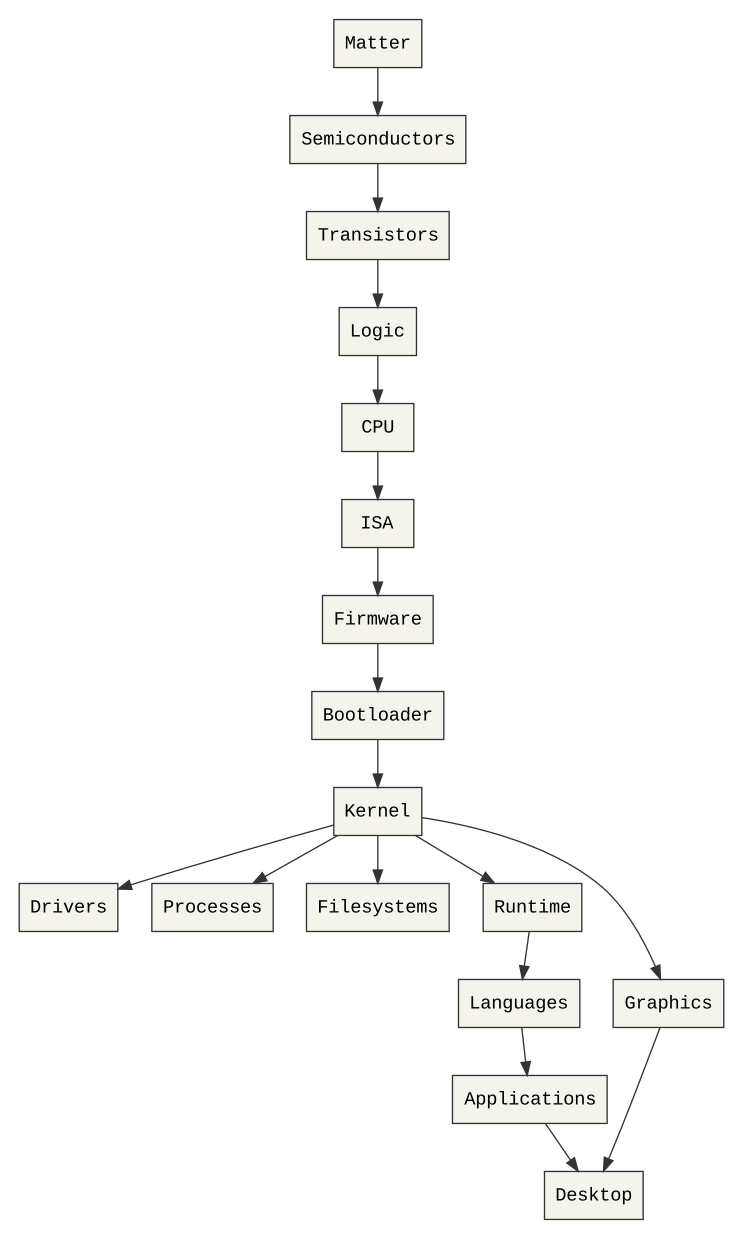
Abstract. ChrisOS is an experimental operating-system ecosystem combining an x86-64 higher-half kernel, ChrisC and CLVM, a native compiler/assembler/linker path, ChrisFS, a graphical desktop, software and paravirtual graphics, and the ChrisVM/ChrisCPU emulator. This documentation builds the prerequisites from the physical foundations of computing and connects them to the concrete implementation in main.
Structure of the corpus
The corpus separates theory, architecture, implementation, validation, limitations and roadmap. A capability is not treated as proven merely because source exists. The Source Atlas is mechanical; authored chapters explain meaning, invariants, ownership, concurrency, failure modes and subsystem relationships.

Collections
| Volume | Scope |
|---|---|
| 01-foundations — Physical and digital foundations | Matter, electrical charge, semiconductor devices, MOSFETs, CMOS logic, Boolean algebra, combinational and sequential circuits. |
| 02-computer-architecture — Computer architecture | Datapaths, control, instruction sets, x86-64 execution, privilege, caches, memory hierarchy, buses, MMIO and DMA. |
| 03-boot — Boot and executable formats | Power-on state, firmware, UEFI, Limine, ELF loading, linker layout and the transition into the ChrisOS entry point. |
| 04-kernel — Kernel architecture | Privilege boundaries, monolithic modular organization, exceptions, interrupts, SMP, processes, ELF user execution and system calls. |
| 05-memory — Memory systems | Physical memory allocation, virtual addressing, four-level paging, CR3, TLBs, heaps, ownership and multiprocessor invalidation. |
| 06-storage — Storage and filesystems | Block devices, ATA/AHCI/NVMe/VirtIO concepts, sectors, DMA, filesystem structures, journaling, ChrisFS and installation. |
| 07-language-systems — Languages and toolchains | Lexing, parsing, semantic analysis, intermediate forms, bytecode, JIT compilation and the ChrisC/native toolchain paths. |
| 08-graphics — Graphics systems | Pixels, color, framebuffers, scanout, composition, rasterization, depth, VirtIO-GPU, VirGL and programmable shaders. |
| 09-emulation — Machine emulation and virtualization | Instruction interpretation, architectural state, buses and devices, ChrisVM/ChrisCPU and the boundary to future hardware virtualization. |
| 10-networking — Networking | Network interface devices, packet movement, Ethernet/IP/UDP/TCP concepts and the current VirtIO networking paths. |
| 11-desktop — Desktop and applications | Window management, composition, input routing, built-in ChrisC applications and system workloads. |
| 12-self-hosting — Self-hosting and bootstrap | Compiler bootstrapping, internally produced objects and executables, kernel rebuild milestones and dependency reduction. |
| 13-real-hardware — Installation and real hardware | GPT, ESP, UEFI boot media, hardware profiles, driver evidence and the distinction between emulation and physical-machine support. |
| 14-validation — Validation and reliability | Host tests, QEMU gates, physical-hardware evidence, invariants, fault containment, stability auditing and reproducibility. |
| 15-specifications — Specifications and formats | ChrisVM contracts, ChrisO, boot protocols, filesystem formats, ABIs, graphics protocols and externally defined specifications. |
| 16-history — Architecture history | Revision-bound history of architectural changes, superseded designs and the reasons interfaces moved. |
Evidence policy
- Current source on main.
- Reproducible tests and gates on the same revision.
- Current in-repository specifications.
- Historical audits, identified by their revision.
- Roadmap explicitly marked as future work.