ChrisFS cache and block allocation
About this chapter ChrisFS structures and recovery
In this chapter
- ChrisFS cache and block allocation
- Scope
- In-memory cache structure
- Cache belongs to one mounted Cfs object
- Cache reset
- Tag lookup
- Duplicate invalidation
- Hit path
- Miss path
- Victim policy
- Write-through design
- Raw versus journal-aware writes
- No delayed writeback
- Read-ahead is a separate path
- Read-ahead requires physical contiguity
- Read-ahead bypasses cache population
- Cache counters exclude read-ahead bypasses
- Cache counter API
- Bitmap structure
- Absolute and relative addresses
- Bitmap reads use the cache
- Bitmap writes are read-modify-write
- Allocation hint
- Initial hint
- Allocation search
- Successful allocation
- Allocation rollback
- Free path
- Free does not zero the block
- Allocation locality
- Fragmentation behavior
- Worst-case allocator complexity
- Cache complexity
- Interaction with the global filesystem lock
- Reentrant locking
- Concurrency validation
- Cache validation evidence
- Allocation validation evidence
- Direct block-device bypasses
- Current limitations
- Roadmap boundary
- Source map and revision note
Scope
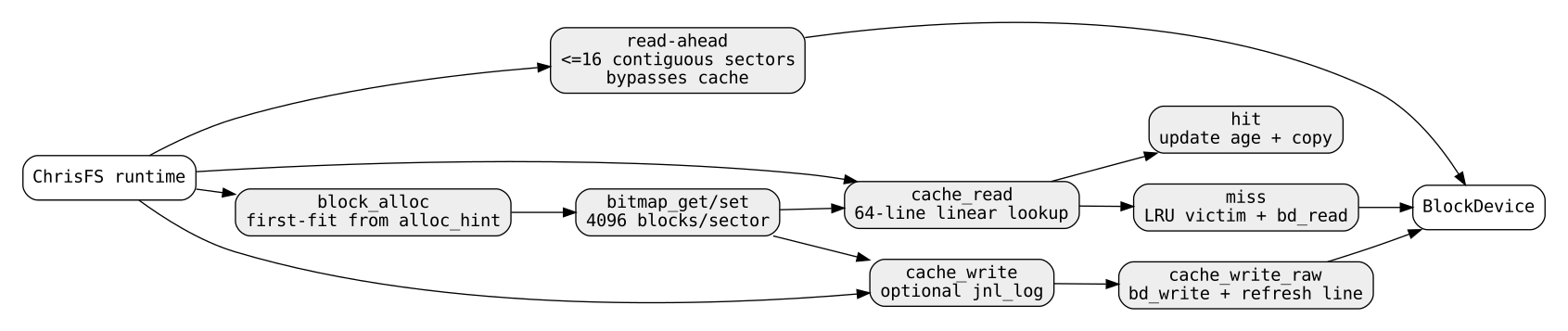
ChrisFS combines two small but central mechanisms in the mounted Cfs object:
- a 64-line sector cache;
- a bitmap allocator with a moving allocation hint.
The cache is intentionally simple:
- one 512-byte sector per line;
- linear tag lookup;
- write-through behavior;
- no dirty lines;
- approximate LRU replacement using an age counter.
The allocator is similarly compact:
- one bit per data-region sector;
- allocation and free routed through the same cached bitmap sectors;
- one
alloc_hintto avoid restarting every search at bit zero.
These mechanisms are tightly coupled to the journal and global filesystem lock. Cache writes are the interception point used by journaling, while allocation mutates bitmap sectors through that same write path.
This chapter documents ChrisOS revision e05a17fd76333114a3fb5c2452f38ca747d4ac56.
In-memory cache structure
Each cache line is:
The number of lines is fixed by:
Therefore the payload capacity is exactly:
plus tag/age/valid metadata and normal C-structure padding.
There is no dynamically sized cache based on RAM or device capacity.
Cache belongs to one mounted Cfs object
The cache array lives inside:
along with:
- the mounted superblock;
- shared 512-byte scratch sector;
- age clock;
- hit/miss counters;
- journal state;
- allocation hint.
The cache is therefore per mounted Cfs object, not process-global.
The filesystem lock is global, however, so two independent mounted Cfs instances are still serialized by the current lock design.
Cache reset
cache_reset:
- sets cache clock to zero;
- resets hit counter;
- resets miss counter;
- marks all 64 lines invalid;
- clears each stored LBA and age.
It does not zero each 512-byte line payload because invalid lines are never consulted.
cfs_mount calls cache_reset before journal replay.
That prevents stale cache content from a previous mount state from influencing the newly mounted filesystem.
Tag lookup
cache_read linearly scans all 64 cache lines.
For every line whose:
it selects the copy with the greatest age.
Normally there should be at most one valid line for an LBA.
The “greatest age” selection plus later duplicate invalidation is defensive behavior against duplicate cache lines.
Duplicate invalidation
On a cache hit, cache_read performs a second full scan and invalidates any other valid line with the same LBA.
On miss and on raw writes, cache_drop_lba invalidates every matching line before installing a new copy.
So the implementation aggressively restores the invariant:
even if an earlier bug or bypass path created duplicates.
Hit path
On hit:
- increment
cache_hits; - invalidate duplicate copies;
- increment global cache clock;
- store that age in the winning line;
- copy 512 bytes to the caller buffer.
The hit path does not touch the backing BlockDevice.
Miss path
On miss:
- increment
cache_misses; - invalidate any stale matching line;
- choose a victim;
- issue one-sector
bd_read; - populate the victim;
- increment age clock;
- copy the cached payload to the caller.
If bd_read fails, the selected victim is not marked valid.
The old victim content may already have been selected logically, but because no dirty writeback exists, eviction itself cannot lose unpersisted data.
Victim policy
cache_victim returns:
- the first invalid line, if any;
- otherwise the valid line with smallest
age.
This approximates LRU.
It is exact with respect to the monotonic age values as long as the 32-bit cache clock has not wrapped.
The implementation has no explicit wrap handling.
After approximately:
the age counter returns to zero and “smallest age means oldest” temporarily stops matching true recency.
This is a long-running edge case rather than an ordinary workload limit.
Write-through design
ChrisFS has no dirty cache lines.
cache_write_raw:
- writes the new sector to the backing device;
- if the write fails, returns
CFS_EIO; - invalidates cached copies of that LBA;
- chooses a victim;
- installs the successfully written sector as a fresh cache line;
- updates age.
The device write therefore precedes cache replacement.
A failed device write does not install the requested new bytes as valid cached state.
Raw versus journal-aware writes
There are two write helpers.
cache_write_raw
Writes directly to the home LBA and refreshes the cache.
It bypasses journal interception.
Used by mechanisms such as:
- journal header/record management;
- replay;
- selected superblock writes.
cache_write
When:
it first calls:
and only then calls:
This makes the cache write layer the central interception point for current journal coverage.
The journal chapter explains why this does not provide full transactional ordering.
No delayed writeback
Because every normal write reaches bd_write immediately:
- eviction never needs to flush a dirty line;
cfs_syncdoes not iterate cache lines;- there is no dirty-list state;
- cache memory pressure cannot itself trigger persistence work.
cfs_sync simply delegates to:
to ask the underlying block layer to flush its own state.
Read-ahead is a separate path
Aligned file reads can bypass the one-sector cache.
cfs_read_at detects a run of physically contiguous file blocks and reads up to:
in one bd_read.
Maximum run payload:
The buffer is the global static:
rather than a per-Cfs allocation.
Read-ahead requires physical contiguity
The code begins with one mapped file block and extends the run only while:
and each next block:
- resolves successfully;
- lies inside the data region;
- fits in the requested read amount;
- keeps the run below 16 sectors.
Logical adjacency in the file is not enough.
Fragmented files fall back to the ordinary one-sector cache path.
Read-ahead bypasses cache population
When a multi-sector read-ahead run succeeds, ChrisFS:
- performs direct
bd_readintog_cfs_ra; - calls
cache_drop_lbafor every sector in the run; - copies the buffer to the caller.
It does not populate those sectors into the cache.
This design avoids stale cache copies after the bypass, but repeated large sequential reads do not automatically warm the sector cache.
Cache counters exclude read-ahead bypasses
cache_hits and cache_misses are updated only inside cache_read.
A direct multi-sector read-ahead:
- is a physical device read;
- is not a cache hit;
- is not a cache miss according to these counters.
Therefore the counters measure one-sector cache activity, not total filesystem I/O behavior.
They should not be interpreted as a complete device-I/O hit ratio.
Cache counter API
The public getters are:
Both enter the global filesystem lock.
That keeps counter reads consistent with cache activity and permits reentrant calls on the same lock owner.
The host test verifies that a normal mount/write/read sequence produces at least one hit and one miss.
It does not assert an exact replacement trace.
Bitmap structure
Allocation state is stored as one bit per data-region sector.
For data-region-relative block index i:
because:
A set bit means allocated.
A clear bit means available.
Absolute and relative addresses
The allocator operates on a relative bitmap index.
Allocated blocks are returned as absolute filesystem-visible LBAs:
Free performs the inverse:
with a data-region range check first.
Bitmap reads use the cache
bitmap_get calls:
and then extracts one bit.
Sequential allocation therefore repeatedly references the same bitmap sector while scanning nearby bits.
After the first miss, following bit probes in that sector can be cache hits.
This is important because one bitmap sector represents 4096 allocatable data sectors.
Bitmap writes are read-modify-write
bitmap_set:
- reads the containing bitmap sector through the cache;
- modifies one bit in
fs->sector; - writes the entire 512-byte bitmap sector through
cache_write.
One block allocation or free therefore causes a full-sector bitmap write.
If journaling is active with metadata logging enabled, that entire bitmap sector can also consume one journal record.
Allocation hint
The mounted Cfs contains:
A source comment explains why it exists:
the allocator previously restarted every search at block zero, making multi-megabyte file copies effectively quadratic enough to stall the installation path.
With the hint, allocation usually continues near the previous successful allocation.
Initial hint
cfs_mount clears the complete Cfs object before initialization.
There is no later explicit alloc_hint assignment during mount.
Therefore the initial value is:
The root directory data block is already marked allocated in the bitmap, so the first ordinary allocation typically skips index 0 and finds the next free index.
Allocation search
block_alloc computes:
If the hint is outside the current data region, start becomes zero.
It then scans at most:
candidate bits.
The index wraps once around the data region.
Therefore every allocation is bounded and can discover a free block anywhere in the bitmap.
Successful allocation
When a free index is found:
- set the bitmap bit;
- zero a 512-byte scratch sector;
- write zeros to the newly allocated data block;
- set:
- return the absolute data LBA.
The zero write ensures previously freed contents are not exposed through normal allocation.
Allocation rollback
If the zeroing write for the newly allocated block fails, block_alloc attempts:
to undo the allocation.
But that rollback return value is ignored:
So an I/O failure during the zeroing stage can be followed by a second failure while clearing the bitmap, leaving an allocated bit for a block the caller never received.
fsck can later classify such unreachable allocation as a bitmap leak.
Free path
block_free first validates the absolute LBA against the current data region.
It then computes the relative index.
If:
it moves the hint backward to that index.
Finally it clears the bitmap bit.
This biases future allocation toward newly created holes below the previous search frontier.
Free does not zero the block
The free path only clears the allocation bit.
It does not overwrite the data sector.
The contents remain on disk until the block is reallocated.
Normal allocation zeroes the block before returning it, so standard reuse does not expose those old bytes.
This is not a secure-erasure mechanism.
Allocation locality
Because successful allocation sets the hint to the following index, ordinary sequential file growth tends to obtain physically consecutive data blocks when the bitmap has a sufficiently large free run.
That has two beneficial consequences:
- fewer bitmap-sector misses during allocation;
cfs_read_atcan later use 16-sector contiguous read-ahead runs.
There is no extent allocator or fragmentation metric, so locality is a side effect of first-fit-from-hint rather than an explicit allocation policy.
Fragmentation behavior
When the hint reaches allocated space, block_alloc continues scanning until it finds the next zero bit.
Freed lower blocks can move the hint backward.
Over time, this creates a first-fit-like reuse pattern.
There is no:
- best-fit policy;
- extent reservation;
- per-file locality group;
- free-run tree;
- fragmentation-aware placement.
The algorithm optimizes simplicity and bounded search rather than layout quality.
Worst-case allocator complexity
One allocation can inspect up to every data-sector bit:
in the worst case.
However, because each cached bitmap sector contains 4096 bits and alloc_hint normally advances, sequential free-space allocation is much cheaper in practice.
Without the hint, allocating N sequential blocks from a growing prefix could repeatedly rescan all prior bits and approach quadratic behavior.
Cache complexity
With a fixed 64-line array:
Hit lookup
for the initial scan plus another O(64) duplicate cleanup.
Miss
tag scan, duplicate drop and victim selection, plus one device read.
Raw write
duplicate invalidation plus victim selection, plus one device write.
The constant is small and predictable, but there is no hash table or direct-mapped indexing.
Interaction with the global filesystem lock
Public ChrisFS operations use:
from fs_lock.h.
The lock is:
- global;
- reentrant by owner;
- spin-based with
pause; - shared by all current ChrisFS activity.
This is necessary for current cache/allocator correctness because the following state is shared and mutable:
- cache tags/data/ages;
fs->sector;alloc_hint;- journal state;
- global read-ahead buffer.
The lock therefore serializes otherwise independent file operations.
Reentrant locking
cfs_read enters the lock and then calls cfs_read_at, which also enters it.
The lock tracks:
and permits the same owner to re-enter.
In the kernel, owner identity is based on current CPU plus one.
The header explicitly warns not to acquire this lock from interrupt context.
Concurrency validation
tools/test_cfs_lock.c runs one writer thread and one reader thread against the same mounted filesystem.
The writer repeatedly replaces an eight-byte file with:
The reader verifies that every successful read contains one consistent repeated byte rather than a torn mixture.
The final filesystem must also pass fsck.
This validates coarse-grained serialization under the host lock model.
It does not validate parallel scalability because the implementation intentionally serializes the operations.
Cache validation evidence
tools/test_cfs_host.c checks that after format, mount, write, remount and reads:
That confirms both paths are exercised.
There is no dedicated cache test that asserts:
- exact LRU victim order;
- 64-to-65-line eviction boundary;
- duplicate-line repair;
- age-clock wrap;
- read-ahead/cache interaction;
- failed-write cache preservation.
Allocation validation evidence
The host suite exercises:
- large file writes;
- directory growth;
- bitmap I/O failure;
- near-capacity namespace behavior.
test_cfs_indirect.c writes and reads 70,000 bytes and finishes with fsck.
The wider test suite and installation path exercise the allocation hint indirectly through large copies.
There is no dedicated unit test that explicitly measures allocation probe counts with and without fragmentation.
Direct block-device bypasses
Not every ChrisFS read or write passes through the cache.
Examples include:
- format-time raw writes;
- some mount diagnostics;
- fsck's direct block-device inspection;
- multi-sector read-ahead.
Therefore cache coherence is maintained only for the normal runtime paths that explicitly invalidate or reset relevant lines.
The global lock prevents concurrent fsck/runtime mutation from being a supported parallel pattern.
Current limitations
At the documented revision:
- fixed 64-line cache;
- linear cache lookup;
- 32-bit age counter with no wrap repair;
- no adaptive sizing;
- no dirty/write-back mode;
- no prefetch insertion into cache;
- read-ahead I/O excluded from hit/miss counters;
- global lock serializes every ChrisFS instance;
- one shared scratch sector per mounted
Cfs; - one global 8-KiB read-ahead buffer;
- allocator is bitmap first-fit-from-hint;
- worst-case allocation scan is linear in data-sector count;
- no extent allocator;
- no fragmentation metric or locality policy;
- allocation zero-write rollback can itself fail and is ignored;
- free does not securely erase old data;
- bitmap changes are full-sector read-modify-write operations;
- repeated bitmap writes can pressure the small journal;
- no dedicated cache replacement or allocator-probe test suite.
Roadmap boundary
A stronger cache/allocation subsystem could consider:
- indexed cache lookup;
- explicit wrap-safe LRU epochs or CLOCK replacement;
- per-filesystem or per-CPU cache partitioning;
- optional write-back with explicit durability semantics;
- read-ahead cache warming;
- counters that distinguish cache reads, readahead reads and raw metadata I/O;
- extent or run-aware allocation;
- free-space summaries to avoid long bitmap scans;
- transactional allocation rollback;
- dedicated allocator fragmentation metrics;
- secure-discard support where backing devices permit it;
- finer-grained locking;
- deterministic eviction and failure-injection tests.
These remain roadmap items until implemented and validated in source.
Source map and revision note
kernel/fs/cfs.h defines CfsCacheLine, Cfs and the cache counters. kernel/fs/cfs.c implements cache lookup/replacement, read-ahead, bitmap access, allocation and free. kernel/fs/fs_lock.h defines the global reentrant filesystem lock. kernel/fs/storage_limits.h fixes sector size and the 64-line cache. tools/test_cfs_host.c, test_cfs_lock.c and test_cfs_indirect.c provide the principal host-side evidence.
All current-behavior claims in this chapter were reconciled against ChrisOS revision e05a17fd76333114a3fb5c2452f38ca747d4ac56.