
ChrisFS inodes and block indirection
About this chapter ChrisFS structures and recovery
In this chapter
- ChrisFS inodes and block indirection
- Scope
- Fixed inode-table geometry
- Inode identifiers
- On-disk inode layout
- Inode types
- Inode checksum
- Inode read/write mapping
- Allocation policy
- Allocation failure behavior
- Permissions stored in the inode
- Generation and modification time
- Block pointers are absolute LBAs
- Pointer-block format
- Direct addressing
- Single indirection
- Double indirection
- Triple indirection
- Effective public file-size limits
- Block allocation
- Lazy tree construction
- Allocation rollback gaps
- Non-sparse invariant
- Distant write_at can violate that invariant
- Shrinking through cfs_write
- Pointer pruning
- Triple-size files and whole-file rewrite
- Inode release for files
- Pointer-table teardown
- Directory-release leak at the single-indirect level
- block_free behavior
- fsck block ownership model
- fsck traversal of pointer trees
- fsck file-size checks
- Validation evidence
- Complexity
- Current limitations
- Roadmap boundary
- Source map and revision note
Scope
ChrisFS inodes are the persistent objects that connect names and directory entries to file metadata and data blocks.
The current format uses a fixed 128-byte inode ABI, a fixed table of 2048 inode slots, and four block-addressing levels:
All stored block pointers are 32-bit absolute LBAs relative to the filesystem-visible BlockDevice. They are not data-region-relative block numbers.
This chapter follows inode state from its on-disk encoding through allocation, lookup, block growth, shrinking, release and fsck validation.
Current behavior was reconciled against ChrisOS revision e05a17fd76333114a3fb5c2452f38ca747d4ac56.
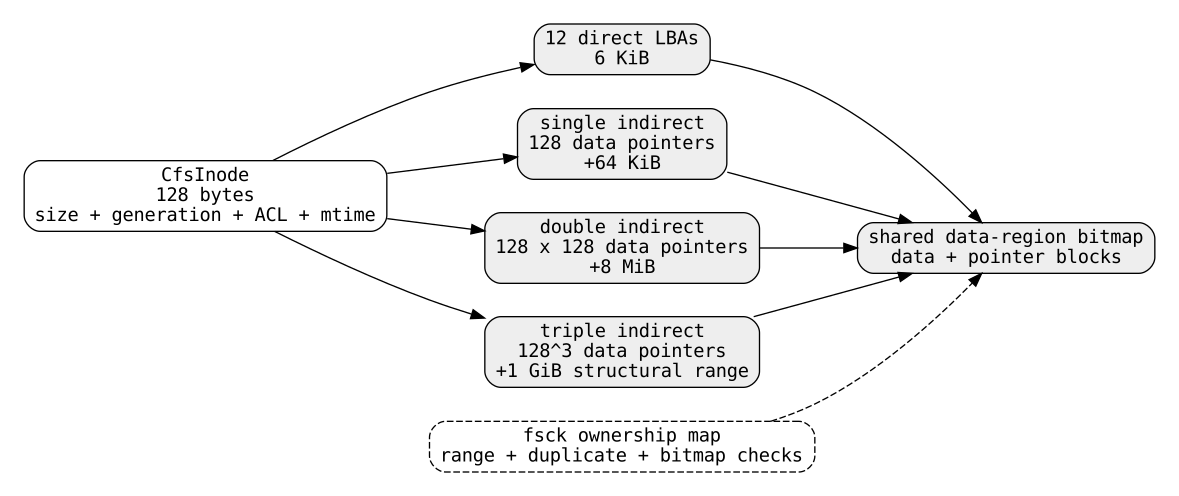
Fixed inode-table geometry
The current constants are:
Therefore:
A compile-time assertion in storage_limits.h enforces that the configured inode table exactly matches those numbers.
In v5, the inode table may move because the bitmap grows, but its size and number of slots remain fixed.
Inode identifiers
Inode IDs are table indexes:
Inode 0 is permanently reserved as:
Normal inode allocation starts at 1.
That leaves at most:
for files and directories combined.
There is no dynamic inode-table growth.
On-disk inode layout
Every inode occupies exactly 128 bytes.
| Offset | Size | Field |
|---|---|---|
| 0 | 2 | type |
| 2 | 2 | flags |
| 4 | 4 | size |
| 8 | 4 | generation |
| 12 | 48 | 12 direct pointers |
| 60 | 4 | single-indirect pointer |
| 64 | 4 | double-indirect pointer |
| 68 | 4 | uid |
| 72 | 4 | gid |
| 76 | 4 | mode |
| 80 | 4 | triple-indirect pointer |
| 84 | 4 | mtime low |
| 88 | 4 | mtime high |
| 92 | 32 | reserved/zero on encode |
| 124 | 4 | checksum |
The encoder explicitly zeros all 128 bytes before writing fields.
That means bytes 92..123 are currently reserved and emitted as zero.
The decoder verifies the checksum but otherwise ignores those reserved bytes. A manually generated inode can therefore place nonzero values there and remain accepted if its checksum is recomputed.
Inode types
The current type values are:
The runtime and fsck reject unsupported nonzero types.
A free inode is represented by a fully zeroed logical inode, encoded with a valid checksum.
This is important: a free slot is not an all-zero 128-byte disk region, because the final checksum field is populated by cfs_inode_encode.
Inode checksum
The inode checksum uses the same 32-bit FNV-1a-like function as the superblock.
It covers:
and is stored at bytes 124..127.
The checksum therefore protects:
- type;
- flags;
- size;
- generation;
- all block pointers;
- uid/gid/mode;
- mtime;
- reserved bytes 92..123.
inode_read refuses a checksum mismatch with:
The host fsck test explicitly flips the stored checksum of inode 1 and verifies that fsck reports:
without writing to the disk.
Inode read/write mapping
Four inodes share one sector.
For inode ID id:
inode_read:
- bounds-checks the ID against
super.inode_count; - reads the containing sector through the filesystem cache;
- decodes and validates the selected 128-byte record.
inode_write:
- reads the containing 512-byte sector;
- re-encodes only the selected inode slot;
- writes the whole sector through the cache.
Thus inode updates are sector-level read-modify-write operations.
Allocation policy
inode_alloc scans linearly:
and stops at the first inode whose type is CFS_INODE_FREE.
When a free slot is found it is initialized as a file inode:
type       = FILE
generation = fs.super.generation + 1
uid        = 0
gid        = 0
mode       = READ|WRITE|EXEC|WALK
flags      = same four compatibility bits
Directory creation first allocates a file-style inode and then changes its type to directory before linking it into the parent.
There is no inode allocation bitmap and no inode allocation hint.
Worst-case inode allocation is therefore:
inode reads per allocation.
At the current fixed table size that cost is bounded, but it does not scale to a large inode namespace.
Allocation failure behavior
Inode allocation itself writes the newly initialized inode before returning its ID.
Higher-level creation must then add a directory entry.
If directory insertion fails, cfs_create and cfs_mkdir attempt to write a zeroed inode back to the slot.
This is local rollback rather than a general resource transaction.
A crash or lower-layer failure between inode allocation and higher-level linkage can still require fsck-level reasoning.
Permissions stored in the inode
The current persistent fields are:
New objects use:
The permission bits are:
For compatibility, effective mode is selected as:
mode, when nonzero;- low permission bits from
flags, when present; - all permissions for any non-free inode when both fields are zero.
The current runtime also rejects objects whose uid is not zero.
So the format has uid/gid fields, but the implementation is not yet a Unix ownership model.
Generation and modification time
An allocated inode receives a generation derived from the current filesystem generation.
Whole-file writes increment:
Modification time is stored as:
which together form a 64-bit value.
inode_stamp increments the global ChrisFS logical clock and records it into those two fields.
The timestamp is therefore controlled by the filesystem clock state rather than being generated from hardware directly inside the inode layer.
Block pointers are absolute LBAs
An inode's pointers contain logical block addresses in the backing filesystem device.
For a GPT-root filesystem this means addresses inside the PartView, not physical whole-disk LBAs.
A nonzero pointer is expected to satisfy:
The bitmap tracks the same data-region blocks by relative index:
Data blocks and pointer-table blocks use the same allocator and bitmap.
Pointer-block format
Each pointer-table sector contains:
little-endian 32-bit LBAs.
There is no header, magic, checksum or level tag in a pointer block.
Its interpretation comes entirely from the inode field and traversal depth.
A zero pointer means “not allocated.”
Direct addressing
The first:
come from:
Capacity:
Direct pointers require no additional metadata block after the inode itself.
Single indirection
After the direct region, the inode's indirect field points to one 512-byte pointer block.
That table contains 128 data-block LBAs.
Capacity contributed:
Cumulative direct + single-indirect capacity:
The directory implementation intentionally stops at this level, giving directories the same 140-block structural ceiling.
Double indirection
The double_indirect field points to a table of up to 128 intermediate pointer blocks.
Each intermediate block points to 128 data blocks.
Capacity contributed:
Cumulative direct + single + double:
This cumulative size is:
and is the hard limit used by the whole-file cfs_write API and cfs_truncate.
Triple indirection
After the double-indirect range, file_lba uses triple_indirect.
The tree is:
The triple region contributes:
The full address tree can describe:
This is the structural pointer-tree ceiling, not the effective public-API file-size limit.
Effective public file-size limits
There are three distinct ceilings in current code.
Whole-file APIs
cfs_write and cfs_truncate enforce:
This stops exactly after double indirection.
Incremental write/read APIs
cfs_write_at and cfs_read_at use:
Crucially, CFS_DATA_SECTORS here is the legacy compile-time 512-MiB geometry constant, not fs->super.data_sectors.
Therefore a larger v5 filesystem does not increase this API ceiling.
Incremental writes can exercise triple indirection, but only up to the legacy-derived ~511.6-MiB limit.
Pointer-tree limit
file_lba itself permits up to:
subject also to:
That is broader than the public incremental API on normal volumes.
The name CFS_MAX_BLOCKS_V4 is historical/misleading because the value includes triple indirection used by current code.
Block allocation
file_lba(..., alloc=1) allocates missing structures lazily.
A newly required data or pointer block is obtained through block_alloc.
block_alloc:
- scans bitmap bits from
alloc_hint; - marks the selected bit allocated;
- zeroes the full 512-byte block;
- if the zero write fails, attempts to clear the bitmap bit;
- advances
alloc_hint; - returns the absolute data-region LBA.
This means newly reused blocks are cleared before being exposed through an inode.
Lazy tree construction
The indirect trees are created only as needed.
For the first single-indirect block:
- allocate
inode.indirect; - read its selected pointer;
- allocate a data block when zero;
- store the new LBA in the pointer table.
Double indirection adds one intermediate table.
Triple indirection can add two intermediate table levels before allocating the data block.
All pointer-table writes use the same write-through cache as normal filesystem metadata.
Allocation rollback gaps
Tree growth is not an all-or-nothing allocation transaction.
Examples:
- a new data block may be allocated successfully and then
ptr_block_setmay fail; - a new intermediate pointer table may be allocated but not yet persisted in its parent;
- the in-memory inode may receive a newly allocated root pointer but later inode persistence may fail.
In those failure windows, the bitmap can retain allocated blocks that are no longer reachable from persistent inode metadata.
fsck detects such leftovers as:
but does not automatically repair them.
Non-sparse invariant
The current fsck model expects ordinary file blocks to exist for the range implied by inode.size.
For direct blocks, fsck explicitly reports:
when a required pointer is zero.
The filesystem does not define an on-disk sparse-hole representation.
Distant write_at can violate that invariant
cfs_write_at updates:
when extending a file.
It then allocates only blocks actually touched starting at offset.
It does not allocate or zero every missing block between the old EOF and a distant new offset.
For example, writing one byte at block 8 of an empty file can leave direct blocks 0..7 unallocated while the inode size says those bytes exist.
Later sequential reads can encounter missing pointers and return:
and fsck can report:
This is not working sparse-file support; it is a current extension-path gap.
A safe caller should currently avoid extending a file across unallocated full-block gaps.
Shrinking through cfs_write
For whole-file replacement with a smaller size, cfs_write:
- calculates old and required block counts;
- rewrites/allocates all blocks still needed;
- walks old blocks beyond the new EOF and frees their bitmap bits;
- calls
inode_ptr_prune; - persists the smaller inode.
For files already within CFS_MAX_FILE_SIZE, this prunes direct/single/double metadata according to the new block count.
Pointer pruning
inode_ptr_prune can:
- clear unused direct pointers;
- clear unused entries from a single-indirect table;
- free a whole double-indirect tree when no longer needed;
- free unnecessary double-indirect intermediate tables;
- clear unused double-indirect leaf pointers.
If the new size needs at most 12 blocks, it calls inode_ptr_free, which also frees the triple-indirect pointer-tree metadata.
Triple-size files and whole-file rewrite
A file enlarged with cfs_write_at beyond:
cannot subsequently be replaced by cfs_write.
Before beginning the write, cfs_write explicitly treats:
as:
Likewise, cfs_truncate eventually delegates to cfs_write.
So triple-indirect files can be created by incremental writes, but the whole-file rewrite/truncate path does not support them.
Unlink remains the practical release path.
Inode release for files
inode_release handles regular files by computing the number of blocks implied by file size and then:
- resolving each block through
file_lba(..., alloc=0); - freeing every reachable data block;
- freeing indirect pointer-table structures through
inode_ptr_free; - zeroing the inode;
- encoding it back as a free inode.
For a triple-indirect file this means the data leaves are freed first and the pointer-table hierarchy is freed afterward.
Pointer-table teardown
inode_ptr_free directly frees:
- the single-indirect table;
- all second-level tables plus the double-indirect root;
- the triple-indirect pointer structure through
free_ptr_levels.
For triple indirection, free_ptr_levels recursively frees pointer-table blocks.
It does not free triple data leaves by itself; regular-file release already freed those leaves by iterating the file blocks.
That separation is correct only when the caller has handled the data blocks first.
Directory-release leak at the single-indirect level
Directories can grow to:
dir_remove clears directory entries but does not free empty directory blocks or shrink the pointer structure.
When an empty directory is finally released, inode_release takes its non-file branch and frees only:
before calling inode_ptr_free.
For n->indirect, inode_ptr_free frees the pointer-table block itself but does not walk and free the directory data blocks referenced by that table.
Therefore a directory that previously grew beyond 12 data blocks can leave its single-indirect directory blocks allocated after rmdir.
Those blocks become unreachable bitmap allocations and can be reported by fsck as leaks.
This is a current resource-lifetime bug, not intended directory semantics.
block_free behavior
Freeing a block only clears its bitmap bit.
The old 512 bytes are not zeroed at free time.
They are zeroed later if the block is selected again by block_alloc.
Consequences:
- ordinary reallocation does not expose stale contents to a new file;
- raw disk examination can still recover old bytes from a free block before reuse;
- a metadata corruption that references a freed block could expose stale content.
There is no secure-delete guarantee.
fsck block ownership model
fsck maintains a “seen” bitmap independently from the allocation bitmap.
For every referenced data or pointer block it checks:
- LBA lies in the data region;
- the block has not already been referenced;
- the allocation bitmap marks it used.
Violations are reported as:
After walking every inode, fsck scans the allocation bitmap for used blocks that were never seen.
That reports:
This catches many allocation-lifetime bugs even though fsck does not repair them.
fsck traversal of pointer trees
For:
fsck walks one pointer-table level.
For:
it walks two.
For:
it walks three.
Both pointer tables and data blocks count as owned blocks.
A pointer-table block is therefore not “free metadata”; it consumes ordinary data-region capacity and must have a bitmap bit.
fsck file-size checks
For files, fsck computes a maximum size from the mounted volume:
capped at:
because inode size is a 32-bit field.
It also verifies direct pointers against the number of blocks required by file size.
However, the current direct-pointer size-vs-block check is not mirrored with the same completeness across all single/double/triple positions; the deeper trees are primarily ownership/range traversed.
Therefore fsck's validation of large-file pointer completeness is not as strict as its direct-block validation.
Validation evidence
Indirect addressing
test_cfs_indirect.c writes and reads:
which exceeds direct-only capacity and requires the single-indirect path.
It then runs fsck.
This validates the single-indirect implementation.
Whole-file maximum
test_cfs_maxwrite.c probes exactly:
and verifies that the first succeeds while the second returns CFS_EFBIG.
The maximum-size success case reaches through double indirection.
Inode checksum
test_cfs_fsck.c corrupts inode 1's checksum and verifies read-only fsck detection.
Missing dedicated triple test
There is currently no dedicated test_cfs_triple, large-write_at boundary test or sparse-gap test in the source tree.
Triple-indirect behavior is implemented, but it has materially less explicit test coverage than single/double paths.
Complexity
Inode allocation
with a fixed current maximum of 2048.
Direct block lookup
with no pointer-block read.
Single indirection
Conceptually O(1), requiring one pointer-table access.
Double indirection
Conceptually O(1), requiring up to two pointer-table accesses.
Triple indirection
Conceptually O(1), requiring up to three pointer-table accesses.
The asymptotic lookup remains constant because tree depth is fixed, although I/O cost increases by level and cache behavior matters.
File release
Regular-file release is:
because inode_release resolves and frees each data block before tearing down pointer tables.
Current limitations
At the documented revision:
- inode table is fixed at 2048 entries;
- only 2047 non-root objects can exist;
- inode allocation is a full linear scan;
- inode size is fixed at 128 bytes;
- inode size field is 32-bit;
- block pointers are 32-bit absolute LBAs;
- pointer blocks have no independent checksum or type tag;
- all data and pointer blocks share one bitmap;
- allocation rollback is incomplete across multi-block tree growth;
- no sparse-file representation exists;
- distant
write_atcan create missing interior blocks; - whole-file APIs stop at ~8.07 MiB;
- incremental APIs use a legacy-derived ~511.6-MiB constant rather than dynamic v5 capacity;
- triple-indirect files cannot be rewritten/truncated through the whole-file API;
- triple indirection lacks dedicated boundary testing;
- freeing does not zero data immediately;
- directory release can leak single-indirect data blocks;
- fsck does not fully verify required occupancy for every deep pointer position.
Roadmap boundary
A stronger inode/block layer should consider:
- dynamic or bitmap-indexed inode allocation;
- a unified file-size contract based on mounted geometry;
- 64-bit file sizes and LBAs;
- explicit sparse-hole semantics or rejection of distant extension;
- complete rollback for failed tree growth;
- checksummed or otherwise protected pointer blocks;
- shared generic traversal for allocation, pruning, fsck and release;
- correct release of all directory indirect data blocks;
- truncation support for triple-indirect files;
- exact deep-tree occupancy validation in fsck;
- dedicated direct/single/double/triple boundary tests;
- crash/failure injection at every pointer-allocation stage.
Those are roadmap items until implemented and reproducibly validated.
Source map and revision note
kernel/fs/cfs_format.h defines the 128-byte persistent inode ABI and checksum. kernel/fs/storage_limits.h defines inode count, pointer fan-out and size constants. kernel/fs/cfs.c implements inode I/O, allocation, block mapping, growth, pruning and release. kernel/fs/cfs_fsck.c validates inode checksums, block ranges, duplicate ownership and bitmap leaks. tools/test_cfs_indirect.c, test_cfs_maxwrite.c and test_cfs_fsck.c provide the principal host-side evidence.
All current-behavior claims in this chapter were reconciled against ChrisOS revision e05a17fd76333114a3fb5c2452f38ca747d4ac56.