Lexical analysis
About this chapter Compiler construction
In this chapter
- Lexical analysis
- Scope
- What belongs to lexical analysis
- ChrisC: explicit tokenization
- Token representation
- Source coordinates
- Character classes
- Identifier length
- Keyword recognition
- Non-keyword identifiers
- Whitespace
- Comments
- String literals
- String escapes
- Adjacent string concatenation
- Unterminated strings
- Character literals
- Integer literals
- Integer suffixes
- Malformed hexadecimal integers
- Floating literals
- Operators and maximal matching
- Punctuation
- Invalid characters
- End-of-file token
- Cooperative yielding
- ChrisC lexical diagnostics
- KCC: scanning on demand
- KCC preprocessing before scanning
- `skip`
- Keywords in KCC
- Operators in KCC
- KCC identifiers
- KCC integer literals
- KCC floating literals
- KCC character literals
- KCC strings
- Comment handling in KCC
- Generated line markers
- Explicit token stream versus scanner-on-demand
- ChrisAsm scanner
- ChrisAsm numbers
- ChrisAsm comments
- CLASM scanner
- CLASM numbers
- CLASM comments and trailing text
- Validation evidence
- Missing lexical tests
- Security and robustness
- Complexity
- Current limitations
- Roadmap boundary
- Source map and revision note
Scope
Lexical analysis is the boundary between raw source characters and the syntactic units consumed by a parser.
In a conventional compiler the lexer usually turns:
into something conceptually like:
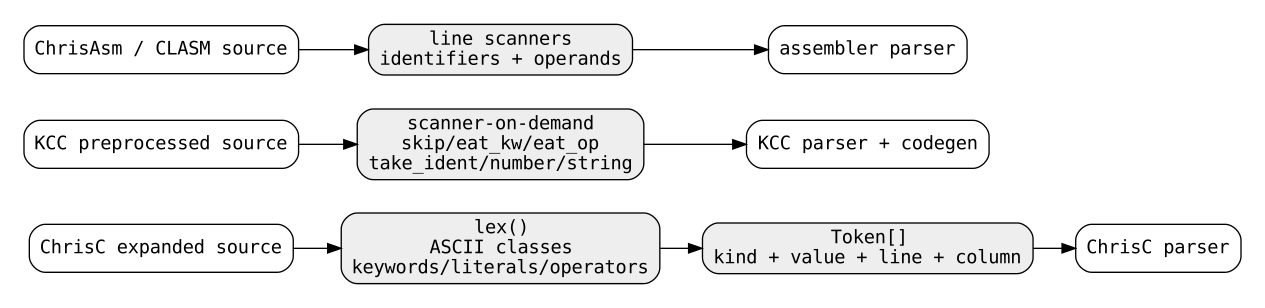
ChrisOS currently implements this boundary in more than one way.
The most important distinction is:
- ChrisC has an explicit lexer that materializes a fixed array of `Token` records before parsing.
- KCC does not have a separate token stream. Its parser scans preprocessed source on demand with helpers such as `eat_kw`, `eat_op`, `take_ident` and `take_number`.
- ChrisAsm and CLASM use smaller line-oriented scanners appropriate to assembly syntax.
This chapter documents those concrete implementations rather than treating lexical analysis as one abstract subsystem.
What belongs to lexical analysis
A lexer normally decides:
- where one token ends and another begins;
- which character sequences are identifiers;
- which identifiers are reserved keywords;
- how numeric literals are decoded;
- how string and character literals are decoded;
- which operator spelling wins when prefixes overlap;
- how comments and whitespace are discarded;
- which source location is attached to a token;
- when malformed character sequences become lexical errors.
It does not normally decide whether:
- a variable is declared;
- an expression has the correct type;
- a function has the correct argument count;
- a control-flow statement is legal in its context.
Those belong to parsing and semantic analysis.
ChrisC: explicit tokenization
The ChrisC lexer is implemented inside:
Its public compiler API hides the lexer, but the compilation flow eventually calls:
after preprocessing has produced the combined translation unit.
The parser therefore receives a materialized token array rather than rescanning source text repeatedly.
Token representation
ChrisC defines:
typedef struct Token {
    TokenKind kind;
    int32_t value;
    int line, column;
    char name[NAME_MAX];
} Token;
The current compiler reserves:
so one compilation can hold at most 262,144 token records and an identifier spelling has at most 47 stored characters plus the terminating NUL.
If the token array is full, token creation fails with:
Source coordinates
The lexer tracks:
while walking the expanded translation-unit buffer.
Every token records the line and the starting column at which it was recognized.
Preprocessing can combine files, so the compiler also keeps line-origin mappings.
When diagnostics are emitted, `line_origin` maps expanded-unit line numbers back to the original source file and source line.
This is the bridge between the expanded translation unit and user-visible `file:line:column` diagnostics.
Character classes
ChrisC uses small ASCII-specific predicates.
An identifier can begin with:
- underscore;
- `a-z`;
- `A-Z`.
Subsequent characters may additionally contain digits.
The current lexer is therefore ASCII-oriented.
It does not implement Unicode identifier categories.
Identifier length
While scanning an identifier, ChrisC rejects a spelling that would exceed `NAME_MAX - 1`.
The error is:
This is safer than silently truncating the identifier because two distinct long names cannot collapse to the same stored spelling.
Keyword recognition
After collecting an identifier spelling, ChrisC passes it through:
The lookup is exact and case-sensitive.
Recognized words map directly to specialized token kinds.
Examples include:
void
int
float
char
struct
if
else
while
for
return
break
continue
long
short
unsigned
signed
const
static
extern
volatile
enum
union
typedef
switch
case
default
do
goto
sizeof
asm
_Generic
_Static_assert
_Alignas
_Alignof
_Bool
restrict
_Noreturn
_Thread_local
_Complex
There are also project-specific compatibility choices.
For example:
- `double` currently maps to the same `T_FLOAT` token as `float`;
- `bool` maps with `_Bool`;
- `register` and `auto` are accepted through the same token path currently used for `inline`.
Those choices are language-profile behavior, not evidence of full ISO C semantic equivalence.
Non-keyword identifiers
If `keyword` finds no reserved spelling, the token kind remains:
The identifier text is copied into the token’s `name` field.
Whether that identifier later denotes a variable, typedef, enum constant, function, member or builtin is decided after lexing.
Whitespace
ChrisC skips spaces, tabs, carriage returns and newlines.
Newline increments the line counter and resets the column to one.
Whitespace is therefore not represented as parser-visible tokens.
Comments
The lexer recognizes both:
Line comments run to newline.
Block comments run until the first closing `*/`.
Nested block comments are not implemented.
If EOF is reached before a closing delimiter, lexing fails with:
Although preprocessing also performs source transformation, comment recognition remains present in the explicit ChrisC lexer.
String literals
When the lexer sees a double quote, it stores decoded bytes in the compiler’s string pool.
The current pool limit is:
A token does not contain the whole string.
Instead, its `value` field stores the starting offset into the shared string pool.
String escapes
ChrisC currently recognizes these special escapes in strings:
For another escaped character, the byte following the backslash is inserted directly.
Full C escape syntax such as arbitrary octal, hexadecimal and universal-character escapes is not implemented by this lexer.
Adjacent string concatenation
After closing one string literal, the lexer skips horizontal whitespace and newlines.
If the next non-whitespace character is another quote, it continues appending to the same string-pool entry.
Thus:
is lexically combined into one string payload.
The final payload is NUL-terminated once the run of adjacent literals ends.
Unterminated strings
A newline or end of source before a closing quote produces:
If the shared pool fills, lexing fails with:
These failures occur before parsing.
Character literals
A character literal becomes:
with the byte value stored in `value`.
Recognized special escapes are:
Other escaped characters become the escaped byte itself.
Missing closing syntax causes:
The current model is a one-byte character-literal model, not the complete C multicharacter/wide/universal literal grammar.
Integer literals
ChrisC recognizes decimal integers and hexadecimal integers beginning with `0x` or `0X`.
A leading zero without `x` does not switch the scanner into octal mode.
The accumulation limit is:
and overflow produces:
Integer suffixes
After the digits, ChrisC consumes repeated:
characters.
The suffix does not create a richer literal-type object in the token. The token still stores one 32-bit value field; later stages interpret type context.
Malformed hexadecimal integers
A source fragment such as:
contains no valid hexadecimal digit and produces:
rather than a zero token.
Floating literals
ChrisC supports a compact decimal float syntax.
Examples recognized by the scanner structure include:
The host `float` bit pattern is stored in the token’s 32-bit `value`.
Important current omissions include:
- exponent notation such as `1e6`;
- hexadecimal floating syntax;
- a distinct double-precision literal representation.
These are language-profile limits.
Operators and maximal matching
Many operators share prefixes:
and:
The explicit lexer tests longer forms before shorter forms in each operator branch.
Supported multi-character forms include:
The parser therefore receives the intended token rather than reconstructing operator boundaries itself.
Punctuation
Single-character punctuation includes token forms for:
Invalid characters
Any character that does not match whitespace, comment syntax, identifier, literal or known operator/punctuation causes:
The compiler does not silently discard unknown bytes.
End-of-file token
After scanning source, ChrisC appends:
with the current line and column.
The parser can therefore recognize normal end-of-input through the token stream.
Cooperative yielding
The lexer calls:
inside its main loop.
If the surrounding compiler integration installed a yield callback, long lexical work periodically returns control to that callback.
This is cooperative progress behavior, not parallel lexing.
ChrisC lexical diagnostics
Important lexical failures include:
source size outside limit
unterminated comment
identifier too long
string pool full
unterminated string
unterminated char
integer literal overflow
bad integer literal
invalid character
too many tokens
Because source-origin mappings are retained, those failures can be mapped back to original files in expanded/include-heavy builds.
KCC: scanning on demand
KCC takes a different architectural approach.
After preprocessing, it sets:
to the preprocessed buffer.
Parser functions inspect and advance this pointer directly.
There is no `Token[]` stage between KCC preprocessing and parsing.
The lexical boundary is distributed across helper functions.
KCC preprocessing before scanning
KCC preprocessing reads logical lines, handles continuations, strips comments, processes directives, expands macros, resolves includes and writes `#line` markers into the output stream.
The parser-side scanner therefore sees already-preprocessed source.
`skip`
KCC’s:
consumes spaces, tabs, carriage returns and newlines.
It also consumes generated:
markers through `parse_hash`.
When a marker is processed, KCC updates `g_file` and `g_line`, preserving diagnostic provenance without storing a source span on every token.
Keywords in KCC
KCC uses:
to recognize a keyword at the parser cursor.
It checks that the character after the candidate word is not an identifier character.
Therefore:
does not match:
The parser itself decides which keyword is legal in the current grammar position.
Operators in KCC
KCC uses:
for operators and punctuation.
The helper performs direct string matching and advances `g_p` on success.
It does not enforce a token boundary after the operator.
Correct disambiguation of overlapping operators therefore depends on parser code checking spellings in a safe order.
That differs from ChrisC’s centralized maximal-munch lexer.
KCC identifiers
`take_ident` accepts:
It consumes the complete identifier from source.
However, only the prefix that fits in the caller-provided destination buffer is copied.
Unlike ChrisC, there is no dedicated lexical “identifier too long” error at this helper boundary.
Callers must therefore size name buffers appropriately, and very long source identifiers can be truncated in local representations.
KCC integer literals
`take_number` accepts decimal and `0x`/`0X` hexadecimal integers plus repeated `u/U/l/L` suffix characters.
Accumulation is 64-bit.
Overflow produces:
This is a wider lexical integer range than current ChrisC.
A leading zero without `x` still does not create octal mode.
KCC floating literals
The current KCC primary-expression path calls `take_number`, `take_char`, `take_string` and identifier parsing.
There is no separate floating-literal scanner in the current source.
KCC has a `TY_FLOAT` type representation, but that does not mean its literal grammar is equivalent to ChrisC’s `T_FNUM` path.
KCC character literals
`take_char` supports one byte and special handling for:
The helper consumes a closing quote if one is present.
At the helper level, however, reaching source end without the closing quote does not directly produce an “unterminated char” diagnostic.
A later parser failure may expose malformed input, but lexical validation is less centralized than in ChrisC.
KCC strings
`take_string` decodes:
and copies into a caller-provided buffer.
It tracks the decoded length even if it exceeds the output capacity, allowing a caller to reject an oversized use.
The helper does not itself reject end-of-input before a closing quote.
Comment handling in KCC
KCC removes comments during preprocessing through:
It supports line comments and block comments, with block-comment state carried across logical lines.
Double-quoted strings are tracked so comment delimiters inside those strings are not treated as comments.
This happens before parser-side scanner helpers run.
Generated line markers
The preprocessor emits markers such as:
into `g_pp`.
`skip` consumes those markers and updates current file/line state.
This replaces the per-token source coordinate model used by ChrisC.
Explicit token stream versus scanner-on-demand
ChrisC advantages
An explicit token stream gives:
- centralized lexical rules;
- one maximal-munch implementation;
- stable line/column per token;
- parser lookahead independent of raw character scanning;
- clear lexical error boundaries.
Costs include a separate scan, token memory and a fixed token-count ceiling.
KCC advantages
Scanner-on-demand reduces token-storage overhead and makes small project-specific parser helpers simple.
Costs include:
- tighter lexer/parser coupling;
- parser-sensitive operator ordering;
- distributed malformed-input handling;
- weaker long-identifier enforcement;
- less centralized diagnostics.
ChrisAsm scanner
ChrisAsm is line-oriented.
Its `parse_ident` reads until whitespace or assembly delimiters such as:
The resulting spelling can denote a mnemonic, register, symbol or directive depending on parser context.
ChrisAsm numbers
`parse_u64` accepts decimal and `0x` hexadecimal spellings and checks 64-bit overflow.
This is an assembler-operand scanner, not a C literal grammar.
ChrisAsm comments
At line start, after whitespace, a line beginning with:
is ignored.
Semicolon also acts as a parser delimiter in instruction syntax.
The lexical rules are intentionally smaller than the C-family scanners.
CLASM scanner
The CLVM assembler uses another small line scanner.
`word` accepts:
for instruction and label names.
Instruction/label comparison is case-insensitive, unlike ChrisC/KCC identifiers.
CLASM numbers
`number` accepts optional minus, decimal and hexadecimal input and accumulates into a 32-bit value.
Its result is used as `int32_t` instruction data.
This grammar is designed for VM operands.
CLASM comments and trailing text
A line tail is empty if it contains whitespace or begins with:
Unexpected extra operand text is rejected by `parse_line`.
CLASM therefore combines small lexical helpers and grammar validation closely.
Validation evidence
`tools/test_chrisc_c17.c` exercises macros, identifiers, literals, operators and many C-like keywords through compile-and-run behavior.
`tools/test_fuzz_chrisc.c` submits deterministic pseudo-random printable source, checks documented success/failure behavior and verifies the compiler still accepts a known-good program afterward.
`tools/test_kcc.c` compiles fixtures and real kernel sources, indirectly exercising KCC preprocessing and scanning across a broad source corpus.
`tools/test_chrisasm.c` checks accepted assembly, unknown mnemonic rejection and relocation-producing symbol references.
`tools/test_clasm.c` checks labels, instructions, integer operands and CLVM bytecode emission.
Missing lexical tests
The current tree does not have a dedicated table-driven ChrisC lexer suite covering every spelling and error.
Useful missing cases include:
- every keyword;
- every multi-character operator;
- maximal-munch conflicts;
- identifier length boundary;
- integer overflow boundary;
- malformed `0x`;
- adjacent strings across lines;
- every supported escape;
- unsupported escape behavior;
- unterminated comment/string/char;
- invalid non-ASCII bytes;
- token-count boundary;
- KCC long-identifier truncation;
- KCC unterminated string/char behavior;
- KCC operator-prefix ordering;
- source-position preservation across nested include/macro expansion.
Security and robustness
Lexers and scanners frequently process untrusted text.
Relevant failure classes include:
- integer overflow;
- buffer overflow;
- malformed escapes;
- unterminated delimiters;
- source-bound errors;
- comment/string confusion;
- ambiguous operator matching;
- pathological rescanning.
ChrisC handles many of these centrally with explicit bounds and hard lexical errors.
KCC uses bounded buffers throughout much of its implementation, but malformed-input behavior is distributed among preprocessing, scanner helpers and parser callers.
Neither compiler should be described as a hardened hostile-input parser without dedicated adversarial testing.
Complexity
ChrisC’s explicit lexer is fundamentally:
in expanded source length for the primary scan.
Keyword lookup is a short chain of exact string comparisons.
KCC has no one lexical pass. Its scanning cost is distributed through parser operations and lookahead.
Most scanning advances forward, but some parser helpers save and restore `g_p`, so lexical cost and grammar behavior are coupled.
Current limitations
At the documented revision:
- ChrisC identifiers are ASCII-only;
- ChrisC identifier storage is limited to 47 characters;
- ChrisC integer lexical values are limited to 32 bits;
- ChrisC supports decimal/hex integers but no octal mode;
- ChrisC float syntax lacks exponent and hexadecimal-float forms;
- ChrisC string/char escapes are a small subset;
- ChrisC uses fixed token and string-pool ceilings;
- KCC has no independent token stream;
- KCC operator matching depends on parser ordering;
- KCC identifiers can be truncated to destination buffers;
- KCC primary-expression scanning has no general float-literal scanner;
- KCC string/char helpers do not directly reject missing closing quotes;
- ChrisAsm and CLASM intentionally use narrower assembly-specific scanners;
- there is no unified lexer library across the language toolchain.
Roadmap boundary
A stronger lexical layer could add:
- explicit language-profile specifications;
- table-driven keyword/operator definitions;
- reusable source-span structures;
- an explicit UTF-8/Unicode policy;
- complete numeric-literal grammar for each supported C profile;
- complete escape grammar;
- standalone lexical tests;
- property-based and coverage-guided fuzzing;
- structured lexical error codes;
- a reentrant KCC scanner context;
- clearer KCC scanner/parser separation;
- source spans preserved through macro expansion.
These remain roadmap items until implemented and validated.
Source map and revision note
The explicit ChrisC lexer, token kinds, storage and source-position logic are in `compiler/chrisc/chrisc.c`. KCC’s scanner-on-demand helpers and preprocessing path are in `compiler/kcc/kcc.c`. ChrisAsm scanning lives in `compiler/chrisasm/chrisasm.c`, and the CLVM assembler scanner is in `compiler/clvm/clasm.c`.
All current-behavior claims in this chapter were reconciled against ChrisOS revision `e05a17fd76333114a3fb5c2452f38ca747d4ac56`.